BND’s loan to the State Mill and Elevator allowed them to expand to better meet the storage and handling of grain.
Ag Loans
Dakota Mill and Elevator (BND Finance Economic Development 2025)
The North Dakota Mill and Elevator and Bank of North Dakota originated in the same piece of legislation in 1919. Today, they remain strong partners serving the state’s residents.
North Dakota Mill and Elevator Association
Nestled in the northeast corner of the state stands the nation’s largest single-location mill: North Dakota Mill and Elevator Association. That’s not the solo trait that makes it truly unique though. ND Mill, which it’s commonly referred to as, is the only state-owned mill in the country and opened in Grand Forks in 1922.
Along with Bank of North Dakota, it was created out of a farmers’ protest and written into North Dakota Century Code by the 1919 legislative assembly. The vision was to improve the value-added market for North Dakota wheat production, a vision that continues to drive its work today.
Although its operations have evolved over time, its mission “to promote and provide support to North Dakota agriculture, commerce and industry” has been steadfast. Fulfillment of its mission could be viewed as two-fold. One part involves generating a revenue that allows the mill to be self-funding and able to return a profit to its owners, the citizens of North Dakota. The other part is providing opportunities for North Dakota growers to be more profitable by receiving a better basis, which is the difference between the cash price and futures price of their wheat.
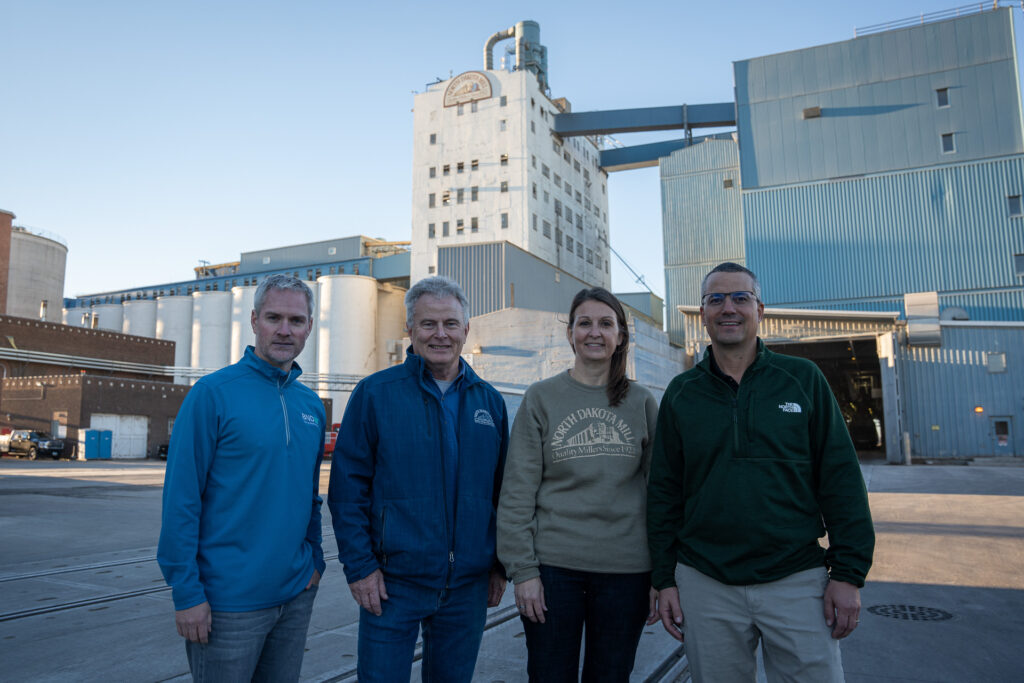
“The question ‘how do we provide more benefit to the farmers?’ has driven a lot of our expansion philosophy,” explains ND Mill and Elevator President and CEO Vance Taylor, who has led the mill for 24 years. “We grind more wheat, create more demand and increase the local basis on what the farmers and the elevators are able to get when they sell their wheat to us. It’s an important part of what we do.”
In its daily operations, ND Mill processes up to 140,000 bushels of wheat and produces 6.05 million pounds of flour and about 2 million pounds of byproduct.
In addition to producing high volumes of product, ND Mill Chief Financial Officer Cathy Dub says, “We’re able to offer the farmers a better basis for their grain because we’re the end user of that product. They’re not paying to ship the grain from here to Minneapolis or to any other markets that may be the end user for the product. We get to use that product here, mill it into flour, and then ship it to our customers.”
No unprocessed wheat leaves the Mill. In fact, more than 300 different types of flour, including conventional and organic products, come off the production lines. Nine out of 10 of its milling units process spring wheat with the last unit milling durum. It purchases the wheat directly from many of the state’s producers as well as from elevators across North Dakota. Taylor explains, “A key to our success is access to some of the best wheat in the world that’s produced in the state of North Dakota by our very skilled producers.”
Another key to success is ND Mill’s dedicated team. There are 170 full-time employees with various levels of education and skill sets working hard to produce and deliver quality products to its customers on time with excellent service.
Success also comes with challenges. ND Mill’s leadership is always strategizing and considering all aspects of its operations including items like food safety standards, maintaining its workforce, anticipating transport logistics and more.
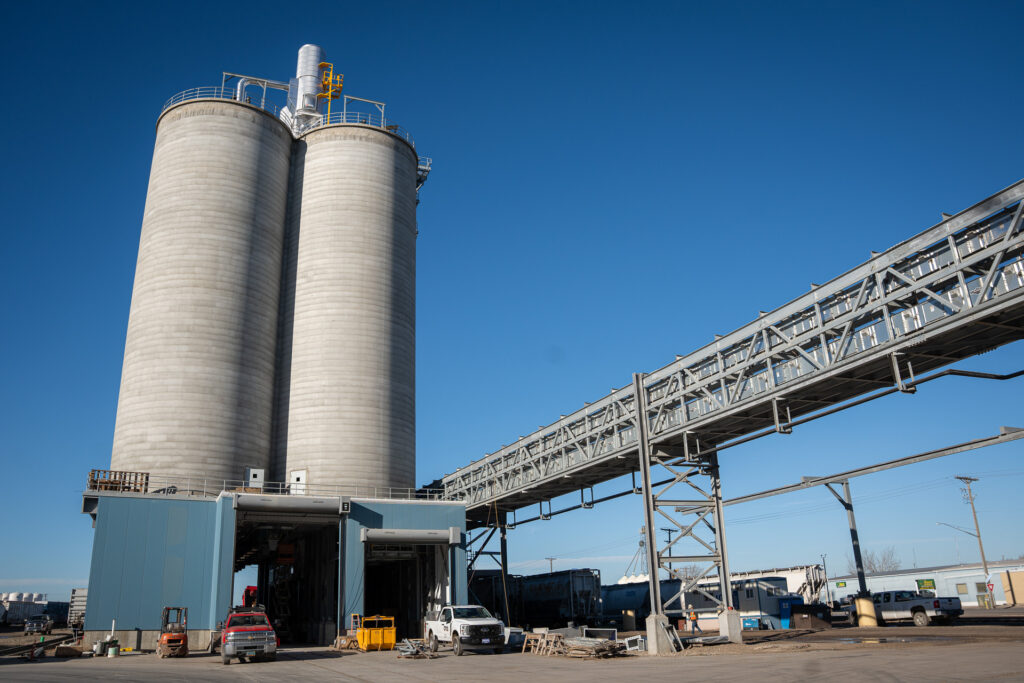
A longstanding challenge ND Mill faced due to its continuous expansion over the past 10 years was the handling and storage of wheat middlings. Middlings, also referred to as midds, are a byproduct of wheat processing, which is commonly used for animal feed. ND Mill’s facility had the capacity to hold three hours’ worth of wheat midds from processing, which made it critical for trucks to be ready to haul the midds out at all times, or part of the milling process would shut down.
After years of planning for a new midds handling-and-storage facility, ND Mill received approval in 2021 of the $56 million project from the North Dakota Industrial Commission, which oversees the ND Mill.
Working with Bank of North Dakota to fund the project, ND Mill recently finished construction of its midds storage-and-handling facility. It was the largest single project that the ND Mill has undertaken since opening its doors in 1922. The new facility increases the midds storage from a few hours’ worth of processing to three days of storage, providing supply reliability conveniences to their midds customers.
“We have a lot of local ranchers, and they struggle to find trucks on weekends to load out,” says Michael Leddige, key account salesman for ND Mill. “Now, we’ll have the ability to load during the week when trucks are coming in to haul grain, and then they can take the midds back to the farm during the week. There is also excitement of not having to worry about storms and having the storage to handle all the midds during the week. If we do get a two-day snowstorm, it makes it a lot simpler overall.”
The new facility reduces the time drivers need to sit in line. While most of the midds customers are local, ND Mill also branches out to customers in Iowa and Nebraska and transports some by rail outside North Dakota to Texas, Oklahoma, Mexico and Canada for example.
ND Mill Packing and Loading Warehouse Superintendent Alan Sundby comments, “When it was talked about putting a new building up a handful of years ago, there was a lot of excitement to get a new facility because the way we’ve been doing it has basically been the same since 1922. It will be nice to be able to efficiently load feed trucks going forward.”
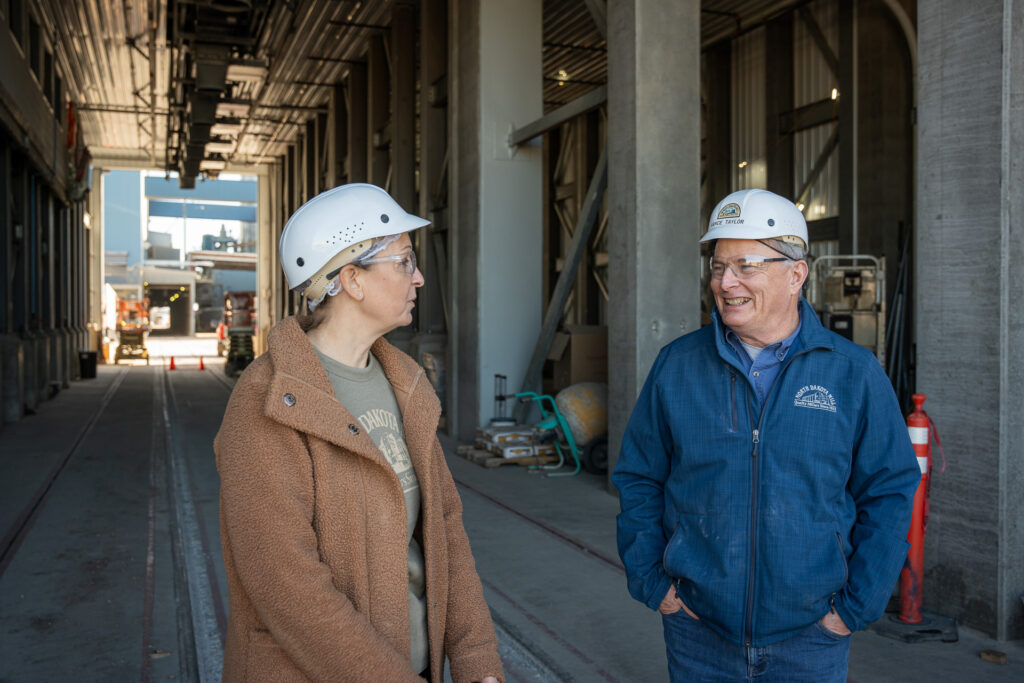
ND Mill’s Chief Financial Officer Cathy Dub adds, “The midds storage-and-handling facility here at the Mill is going to have great impacts on us financially, but also give us a lot of room to run our business in truly the most efficient way, which is going to obviously increase our profits and just be an all-around better process for us. We’re excited to be moving into a facility that better fits our size and is going to allow us much more efficiency.”
While the midds facility is one facet of its operations, it’s an important piece to meet the Mills’ goal of reducing waste and providing value add.
An average consumer may see the Dakota Maid flour product on local grocery shelves, but the majority of ND Mill’s flour product is sold in bulk. In addition to its North Dakota customers, main market areas include New York City and down the east coast, Chicago, Detroit, Indianapolis and the surrounding areas. The product is shipped by railcar or trucked out, some of which route to ND Mill’s many transfer sites in the market areas.
“Sixty percent of our products are shipped out by bulk railcar. Many of those go to the largest bakeries across the country,” Taylor explains. “On the outbound flour side, we ship about 20 bulk trucks a day, somewhere in the neighborhood of 20 to 30 van loads a day of bag product, and on top of that, we ship about 15 to 20 bulk rail cars per day to all parts of the country.”
The nationwide market helps ND Mill create a favorable market for the state’s grain producers and elevators as well as turn a profit on its operations. Fifty percent of the profits are returned to the State of North Dakota and the general fund. These accomplishments come from the ND Mill’s proficient handling of operational logistics from the intake of wheat to the milling and selling of the flour to getting it to the end consumers.
Taylor expresses, “We couldn’t do what we do without the support of the Industrial Commission, which acts as the board for the ND Mill, Bank of North Dakota, the Legislature and our local government here. They’re great to work with and give us the support that we need to do the business we do.”
With no guidebooks on running the only state-owned mill in the country, everything ND Mill achieves is trailblazing and benefits the state of North Dakota, its producers and citizens. Dub adds, ”We’re able to offer the residents of North Dakota and grain producers of the state of North Dakota better returns and a greater advantage by using the tools from Bank of North Dakota to invest in and grow our business.
BND Partnership (30)
BND partners with local lenders to distribute its loan programs across the state.
AGT Food and Ingredients
AGT Food and Ingredients (AGT Foods) is one of the largest suppliers of value-added pulses, staple foods and food ingredients in the world with approximately $3 billion in sales. Having started in 2000, it’s grown from a single location in Canada to an international company with more than 40 locations worldwide. Three of the locations are in North Dakota: one in Williston and two in Minot. They’re making an impact in the state that goes beyond sales.
In 2007, AGT opened a facility in Williston, North Dakota, where they process peas and lentils into whole, split products and package them in bulk for distribution. Then in 2012, a milling facility was established in Minot, North Dakota. There they mill flours, proteins, starches and fibres and work with major food companies to incorporate pea, lentil and chickpea proteins into its food products. All these products are distributed worldwide.
“We’re not going to get people to eat split pea soup, but I can guarantee you they’ll eat that chip with the peas in it because it’s something they’re used to, and it gives them the taste and texture that they want. We’ve made pulses convenient to where you can eat them in many different forms and enjoy the nutritional benefits,” AGT Foods Division Head for Global Food Ingredients Eric Bartsch shared about the company’s innovative approach.
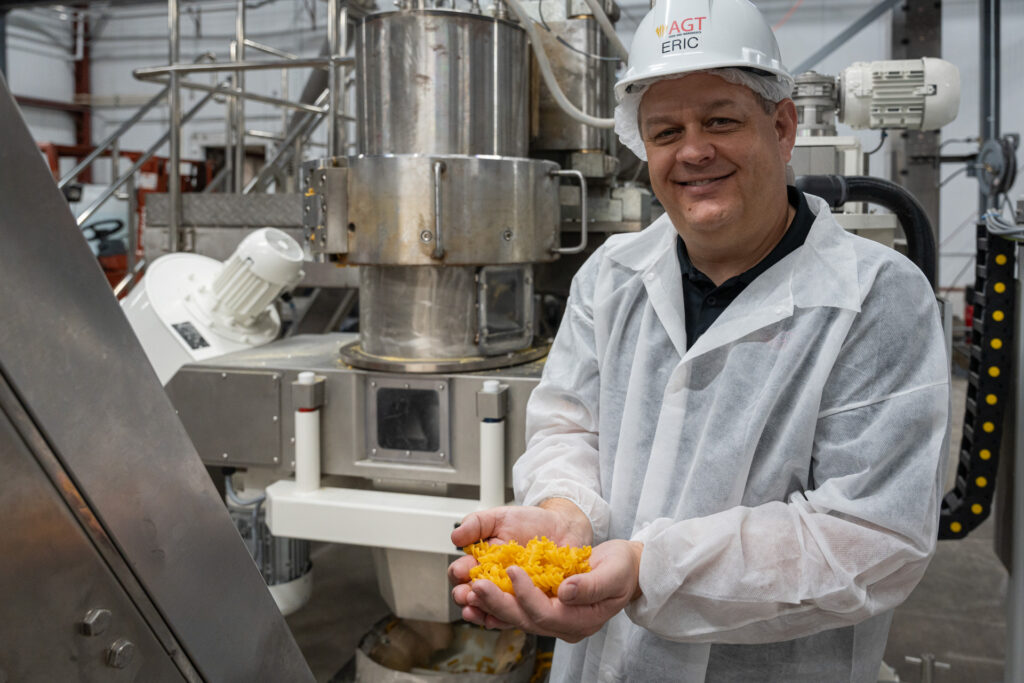
To expand that innovation and technology, AGT Foods recently worked with Senior Vice President and Commercial Banking Manager Zach Burdick from First Western Bank & Trust to fund a second facility in Minot: a gluten-free pasta factory. A vacant building was renovated for the factory and pasta equipment was added. The Minot factory is the first of its kind not only in the company, but in the world for its size, scale and contribution to how they’re transforming pulses. It was a large project and provides new opportunities for AGT Foods and its team.
When it comes to building the right funding deal for the project, Burdick said, “BND’s PACE Loan Program was a perfect fit given the business expansion and future job creation. The interest buydown function of this program has proven even more important in a rising interest rate environment. Jackie Duke at BND was instrumental in this process and was able to roll in the North Dakota Department of Agriculture’s Agriculture Diversification & Development (ADD) Fund to increase the interest buydown commitment. The ADD Fund was a perfect fit as well given its mission for value-added agriculture.”
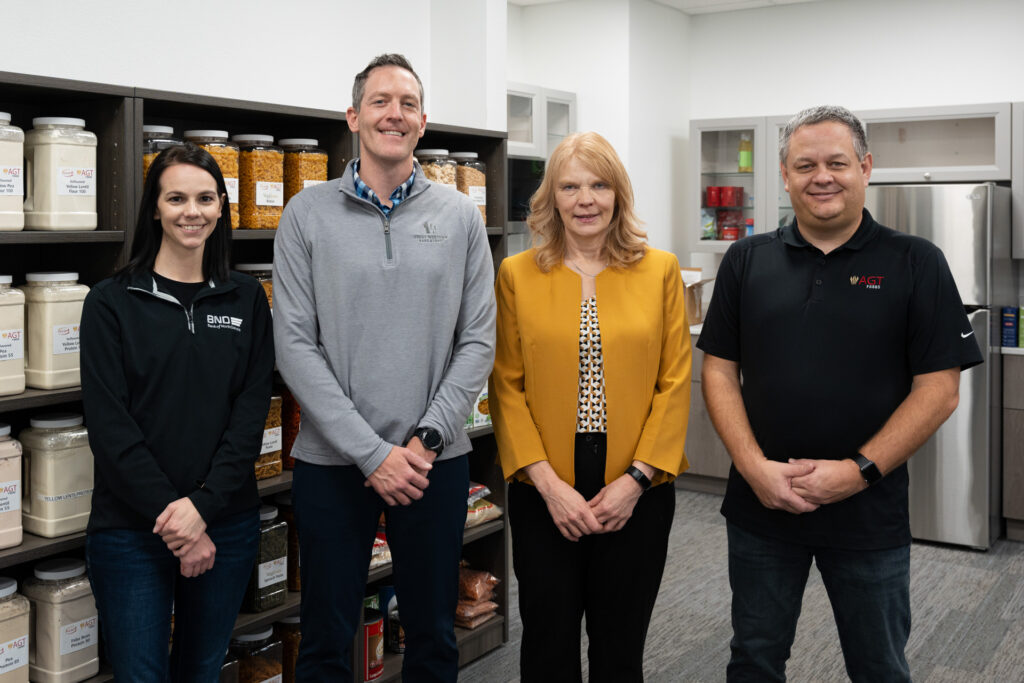
Bartsch added, “One of the biggest futures of our company is this process that we developed to produce gluten-free pasta. The fact that we’ve proved it out and are working with our partners, First Western Bank, Bank of North Dakota, the city of Minot and others means we can make a much bigger investment to expand the capacity and take us to the next level. We’re poised to greatly expand and add multiple product lines within this building and the infrastructure. To me, it’s going to be a world-renowned facility for gluten-free. Today gluten-free products are often imported from Europe because there’s little ability to produce it in North America. We’re going to change that now and really become a big player in producing gluten-free pasta.”
To get the factory up and running, AGT brought in 25 employees, and that number continues to grow. The employees have been recruited from Minot and all over the world, including California, Washington, Africa and even Turkey. In North Dakota, AGT has approximately 175 employees.
BND Business Banker Jackie Duke said, “AGT Foods is paying a livable wage, so they’re getting people to move from out of state to make a career for themselves. It’s kind of a domino effect that Bank of North Dakota, the city of Minot, First Western Bank & Trust and other partners have helped fund the project, but really AGT is helping the whole community so much. The employees are spending their dollars in the community, which is a much larger dollar amount than the buydown dollars toward the loan. AGT is also getting their raw materials from local producers.”
AGT strategically locates its facilities near quality growers and has a mission of “from producer to the world.” This strategy makes North Dakota a perfect fit.
Enger Grain and Livestock
“It’s not a business. It’s a way of life.” These are the words of Jeff Enger, one of two Enger brothers carrying on the Enger Grain and Livestock operation their dad started in the Litchville-Marion area in 1945. Jeff joined his dad in 1970, followed by his brother, Delray, in 1985. They pool their talents with Jeff and his son Justin carrying the grain farming and equipment maintenance responsibilities, and Delray and his son Brandon managing the livestock.
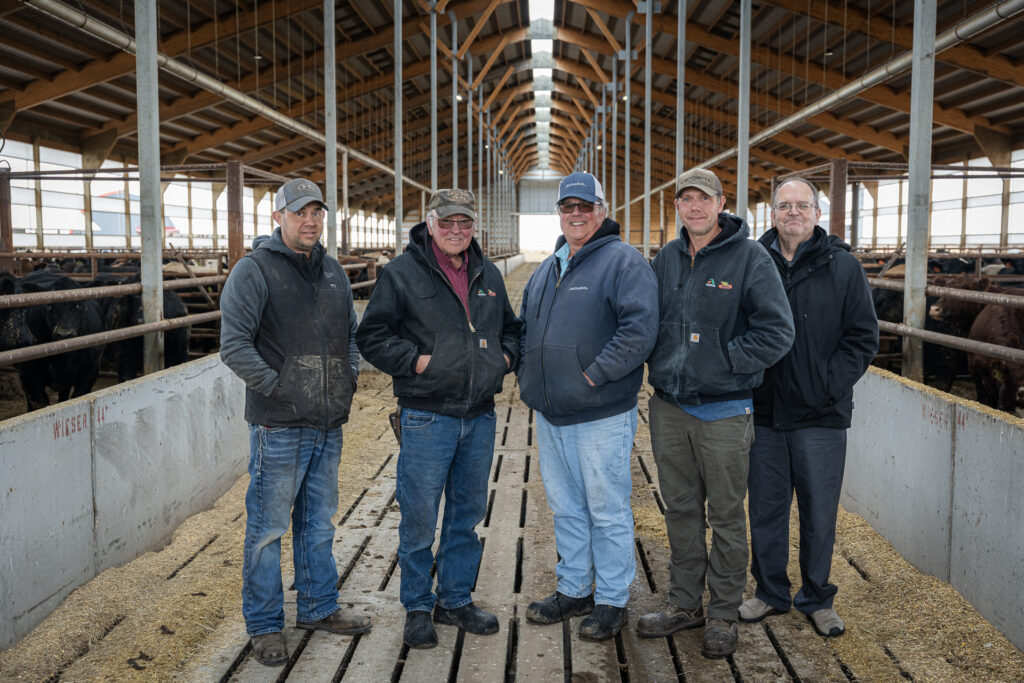
Both have children and grandchildren involved in the family-owned business. Jeff shares this about continuing the legacy, “When you treat it as a way of life, you just really live it, and you don’t want to be some other place. This is your life, so that’s what you do. That gives you the passion and desire to do what you do. I think heritage is really important to carry on that legacy.”
In the ongoing effort to remain viable, Engers exercise forward-thinking mindsets and keep up with industry trends with research and by serving on ag-related committees. They recognize the crucial need to diversify and change with the times. For example, the livestock side of the operation started with hogs until the dynamics of the industry changed. Today, they focus their efforts on growing the cattle feed operation.
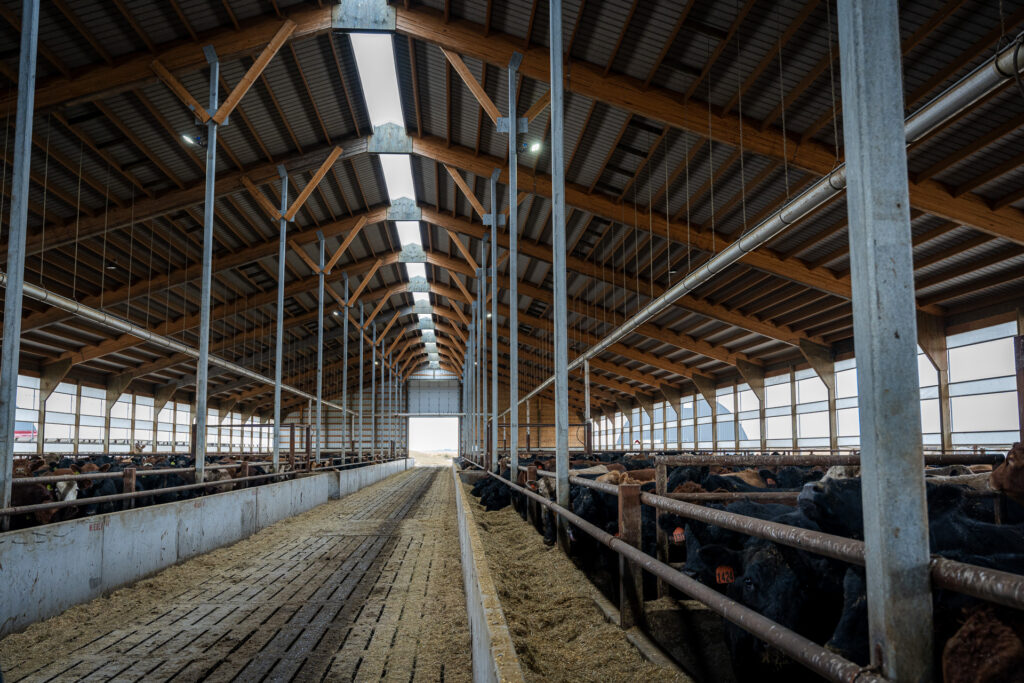
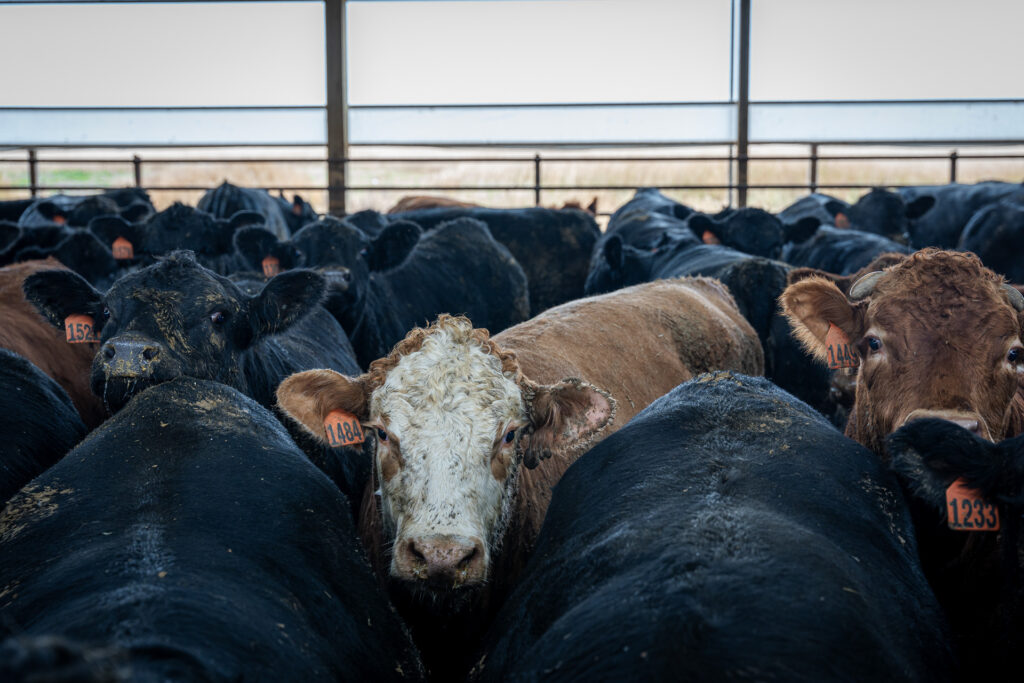
To accomplish this, they recently invested in hoop barns and a slated-floor finishing barn that allowed them to triple their livestock volume.
Building the finishing barn opened possibilities for them to not only increase their cattle volume, but with 3,000 head of cattle, the manure is plentiful. The Engers are considering the value of using that manure on their own fields and eventually offering it to neighboring producers. This could help to reduce need for commercial fertilizers, which is a volatile market. They are also positioned to use by-products with a nearby ethanol plant and future soybean facility.
Mark Oberlander, senior agricultural banker from Dacotah Bank, explained, “We have a long-term relationship with the Enger family and see this [the finishing barn] as a way to get to the next generation. This is an area of very competitive land renting, and it’s a way for them to expand their operation without having to get additional land involved too. It’s a real nice fit and probably the best diversification because you have a cattle feeding aspect and a grain production aspect. Usually in ag, when one area is a little weak, the other one is stronger, and they’ve been able to leverage that.”
Finding the best funding option is key. The Engers worked with Oberlander to access Bank of North Dakota’s BioFuels Partnership in Community Expansion (PACE) Loan program to finance the big barn. He continues, “The assistance on the interest buydown was crucial to get this off the ground. The idea is to get them established with the big barn, which was extremely more expensive than the first and the hoop barns. Providing the interest buydown on the front end allows time for them to get their feet on the ground with the feeding operation. After that, full payments will kick in. We were able to get a better interest rate because of this program.”
Jeff added, “To have a livestock lender that understands you, is at the table, and understands your operation as much as you do is really important. That’s been a great asset and in growing the industry.”
This sentiment is why BND is so appreciative of the local lenders who deliver its loan programs. “No one understands their customer’s needs better than the local lender. They serve as a conduit to deliver opportunities that impact main streets and gravel roads across the state,” states BND Business Banker Andrew Tweet. “Maintaining that local relationship is critical to ensure we are meeting the needs of the agriculture community.”
The Engers have a front-row seat in the challenges of being an ag producer today. Jeff shares, “The price of land and facilities is getting so expensive that eventually it could eliminate a family farm. Nostalgia doesn’t do it. How do we keep that opportunity there for younger people?”
Fortunately, the Engers’ passion for keeping their operation going into future generations is evident and they pass that spirit along in the industry.